 Now What
Free printable medication list template for your aging parent
Short answer: a good medication list records every medication and strength exactly as the label says, how much and when, what it's for, who prescribed it, and allergies at the top, plus over-the-counter medicines and supplements. Our free PDF template has room for all of it, with a contacts page and a log for changes, as part of an 8-page medical binder starter.
When you're suddenly managing a parent's medications, the hardest part is often just knowing what they take. This list gives you one place to write it down, keep it current and share it.
What you get: the medication list template, printed landscape on US Letter paper, with a contacts page that gives each prescriber and pharmacy a short code and a changes log to record every change. It comes inside our free 8-page medical binder PDF, so the other binder pages are there if you want them.
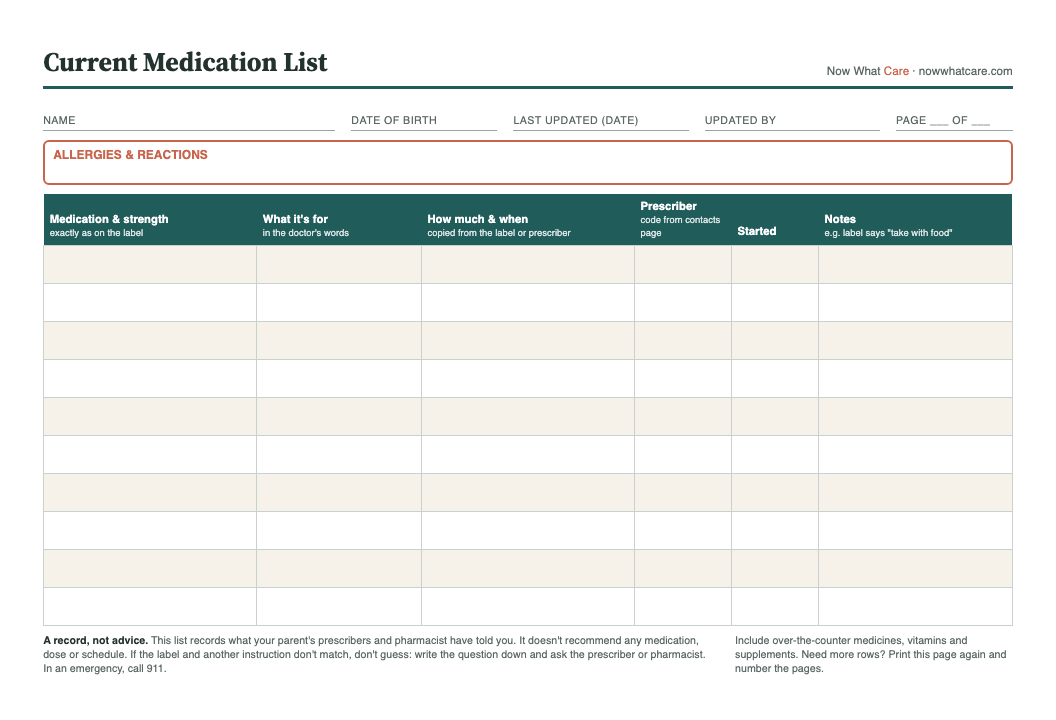
What should be on a medication list?
- Each medication and its strength, copied exactly from the pharmacy label.
- How much and when, as the label or prescriber gives it.
- What it's for, in the words the doctor used, so everyone helping understands.
- Who prescribed it, using short codes that point to a contacts page with each prescriber's and pharmacy's phone number.
- Over-the-counter medicines, vitamins and supplements, not just prescriptions.
- Allergies, at the top where anyone can see them.
- A changes log, so the current list stays clean while the history of what changed, when and who said so stays on file.
How to fill in the template
- Gather every bottle and box your parent takes, including anything over the counter.
- Fill in the contacts page first and give each prescriber and pharmacy a short code (P1, P2, Rx1).
- Copy each medication's name, strength and "how much and when" word for word from the label or the prescriber's written instructions.
- For "what it's for," use the doctor's or pharmacist's words. If you don't know, leave it blank and ask.
- Write the date and your name in "Last updated" and "Updated by."
A filled-in example: the changes log
The current list shows what's true today. The changes log, on the contacts page, is where the history goes, so nobody has to remember it. Its columns, with a made-up entry:
- Date: Oct 3
- Medication: the name and strength, exactly as on the label
- What changed: written as you were told, for example "instructions changed, new label to pick up"
- Who said so: P1, the prescriber's code from the same page
- Recorded by: Dana
Then rewrite that line on the current list from the new label, and replace every older copy. Notice what's not in the log: anybody's guess. Every change traces back to a label, a written instruction or a named prescriber or pharmacist.
When the hospital list and the bottles at home don't match
After a hospital stay, the discharge papers often list medications differently from what's in the cabinet at home: new ones, changed ones, ones to stop. Don't try to work out which is right yourself.
- Write both versions side by side: what the discharge papers say and what the bottles at home say.
- Mark every difference, even small ones like a different strength or time of day.
- Call the prescriber or the pharmacist with the list in front of you, and write down what they tell you, with the date and their name.
- Only then rewrite the current list and log the changes.
For the rest of the first days home, see planning a parent's hospital discharge day.
Questions to ask the pharmacist about the list
- Is this list complete, including over-the-counter medicines and supplements?
- Which of these are new, which changed and which were stopped?
- Are any of these the same medicine under two different names, such as a brand and a generic?
- What is each one for, in plain words we can write on the list?
- Who should we call if we have a question after hours?
How families use it
Keep one copy with the medications and one in the bag that goes to appointments. When a doctor or pharmacist changes something, log it, rewrite the list, and replace every older copy so there's only ever one current version. Hand a copy to anyone who helps with care, and ask the doctor or pharmacist to check it at the next visit.
This list is a record-keeping tool. It doesn't tell you what to take, when to take it or whether to change anything. If two instructions don't match, write the question down and ask your parent's prescriber or pharmacist.
Getting organized for the first time? The same download is a full printable medical binder, and the caring for aging parents checklist shows what else to gather, in order.
Common questions
What should be included on a medication list?
Each medication and its strength exactly as the label says, how much and when, what it is for, who prescribed it, and the pharmacy. Include over-the-counter medicines, vitamins and supplements, and put allergies at the top where anyone can see them.
Is this medication list template free?
Yes. The Now What Care medication list is part of a free 8-page PDF for US Letter paper: the current list, a contacts page with a changes log, an appointments log, a daily care checklist, an insurance and ID sheet, questions for the next visit, and instructions. It is made for printing and filling in by hand.
How do I keep a medication list for an elderly parent up to date?
When a doctor or pharmacist changes anything, log the change with the date and who said so, rewrite the current list, update the Last updated date, and replace every older copy, including copies on the fridge, in bags and on family members' phones.
What should I do if the label and another instruction don't match?
Don't pick one. Write the question down and ask your parent's prescriber or pharmacist before anything changes.
What should I do if the hospital medication list doesn't match the bottles at home?
Don't decide which is right yourself. Write both versions side by side, mark every difference, and call the prescriber or pharmacist with the list in front of you. Write down what they say, with the date and their name, then rewrite the current list and log the changes.
What is a medication changes log?
A record kept alongside the current medication list, with the date, the medication, what changed as you were told, who said so and who recorded it. After each entry you rewrite the current list and replace older copies. It keeps the current list clean while the history stays on file.
Who should have a copy of the medication list?
Keep one copy with the medications and one in the bag that goes to appointments and the hospital, and share copies with family members and anyone who helps with your parent's care. Bring it to every appointment and ask whether it is complete and correct.